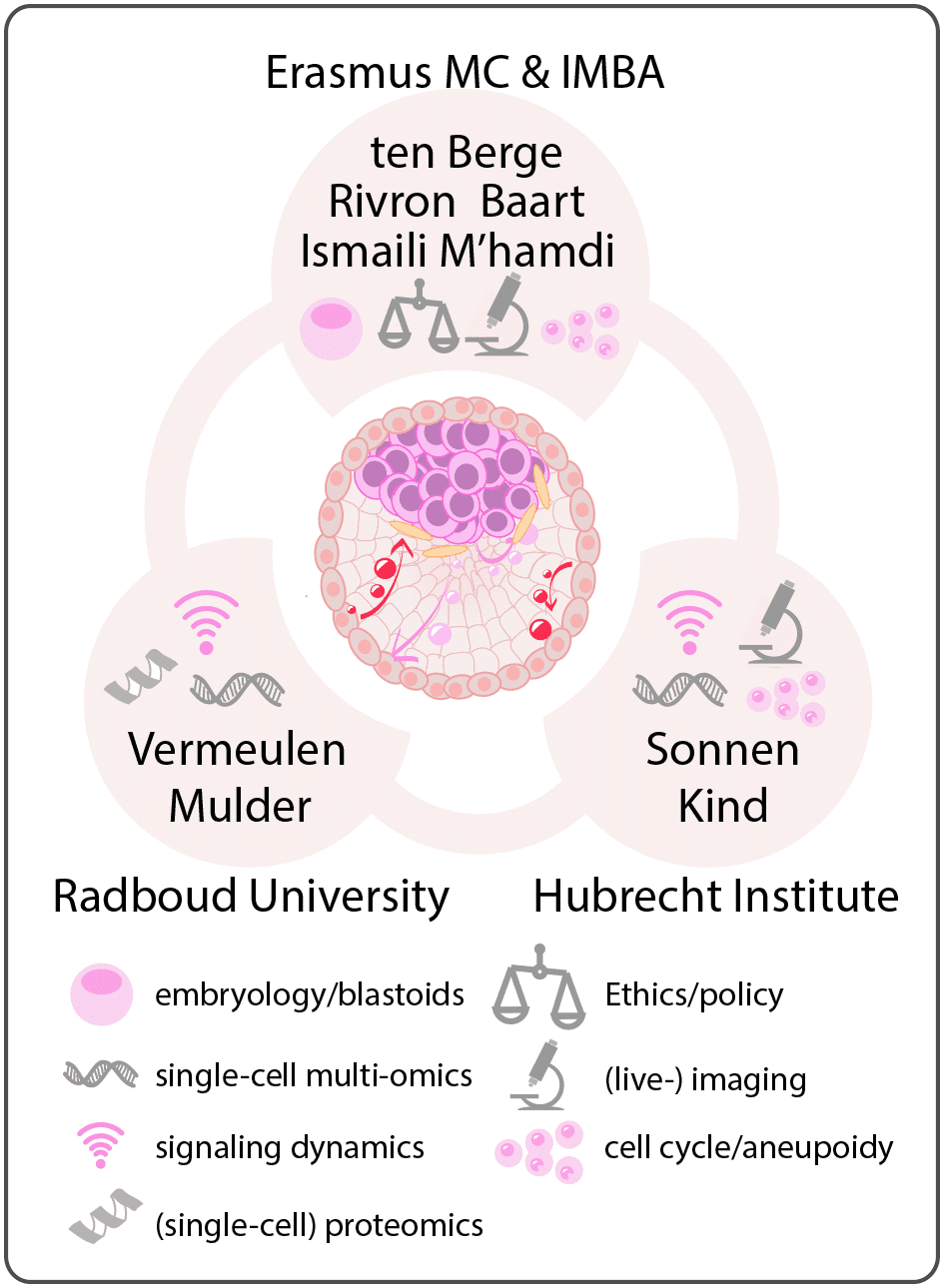
 Our consortium consists of a multidisciplinary team of eight early-career and more established scientists with complementary research backgrounds. The consortium members are pioneers in fundamental and clinical embryology (Baart, Rivron, ten Berge), single-cell transcriptomics and proteomics (Mulder, Vermeulen and Kind), imaging of signaling dynamics using microfluidics (Sonnen), and ethics of human reproduction and blastoids (M’hamdi and Rivron). Attie Go (Gynecologist-perinatologist, Erasmus MC), a pioneer in the application of non-invasive prenatal testing, advises the project group on clinically relevant questions that can be targeted in our experimental models, while Rachèl van Hellemondt advises the ethics team on legal matters. In this proposal we leverage these disciplines to form new human embryo models and obtain unprecedented molecular insights into normal and abnormal early human development. International collaboration is guaranteed by the collaboration with Rivron (IMBA, Vienna).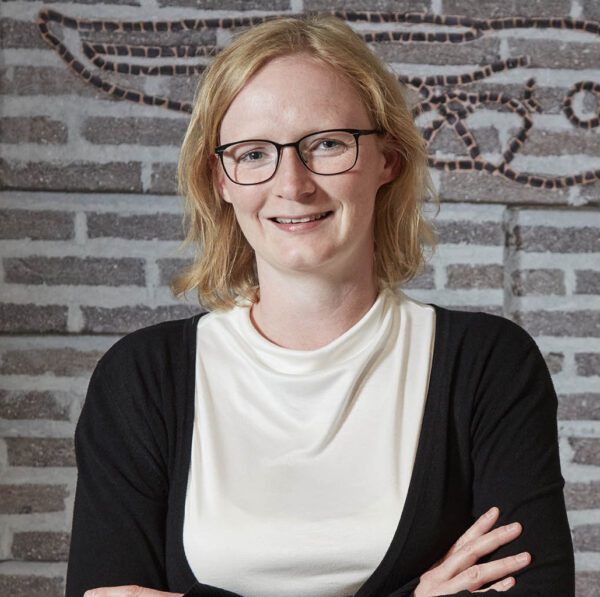
Ina Sonnen
Ina Sonnen is a group leader at the Hubrecht Institute. Within the Beyond the Blastocyst consortium she investigates how signalling pathways and in particular signalling dynamics regulate early human development. She obtained her PhD in 2012 from the University Basel, Switzerland, for her research in the lab of Erich Nigg at the Max Planck Institute of Biochemistry, Munich, and Biozentrum Basel. Combining cell biological and biochemical techniques with super-resolution microscopy she studied the structure and duplication of centrosomes during cell proliferation. She then performed postdoctoral work at the European Molecular Biology Laboratory (EMBL) in the groups of Alexander Aulehla (developmental biology) and Christoph Merten (microfluidics) to study how signalling pathways control periodic segmentation of the vertebrate embryo (somitogenesis). There she established a microfluidic system, which allows simultaneous perturbations of signalling pathways at high temporal precision with real-time imaging. She has used this to dissect the function of signalling oscillations during somitogenesis. With her own group at the Hubrecht Institute Ina combines these techniques with biochemical and single-cell techniques to study the function and mechanism of how signalling and signalling dynamics control both embryonic development and adult tissue homeostasis. In collaboration with other groups, she has established gastruloids as embryo-like model system of somitogenesis.